San Diego County's rainy season doesn't forgive neglected gutters. Here's what local homeowners need to know before the first storm arrives.
Share:
Summary:
Most of the year, your gutters sit quietly up there doing nothing — and that’s exactly when debris is quietly doing its worst. By the time November rolls around and the first real rain hits San Diego County, gutters that haven’t been touched since spring are already packed with dry leaves, jacaranda blooms, and whatever the last Santa Ana wind decided to deposit up there. The overflow isn’t bad luck. It’s a pattern, and it’s preventable. These five tips are built around what actually happens to gutters in Temecula, Spring Valley, Escondido, Encinitas, Oceanside, Chula Vista, Alpine, and Bonita — not generic advice written for somewhere with a normal rainy season.
San Diego County averages 10 to 12 inches of rain per year, but almost all of it falls between November and March. That’s a short window with a lot of water, and it arrives right after the dry season when gutters have been accumulating debris for months without a single drop to flush them out. The math isn’t in your favor if you’re not staying ahead of it.
Temecula adds another layer to this. The wine country hills surrounding the city are covered in mature oaks, and oak debris — leaves, acorns, bark — is some of the most stubborn gutter-clogging material there is. It compacts, it decomposes slowly, and it doesn’t rinse away easily. Spring Valley’s hillside terrain creates a different problem: water moves faster on slopes, so when gutters overflow, it doesn’t just drip off the edge — it runs, and it runs toward your foundation.
Here’s something that surprises a lot of homeowners: your gutters can fill up significantly even when it hasn’t rained in months. Santa Ana wind events — those strong, dry offshore winds that sweep through the inland valleys — carry debris from surrounding hillsides and deposit it into gutters across Escondido, Temecula, Spring Valley, and beyond. You can have a gutter that looked fine in September and find it packed by mid-October without a single drop of rain touching it.
Then there’s the jacaranda problem. If you’ve lived in San Diego County for more than a year, you already know what those purple blooms look like on the sidewalk in May. What they look like inside a gutter is worse — dense, compacted mats that don’t break apart easily and block water flow just as effectively as a fistful of leaves. Jacaranda season runs roughly April through June, which means spring cleaning isn’t optional if you have one of these trees anywhere near your roofline.
The practical takeaway here is that a twice-yearly cleaning schedule — once in fall before the rains, once in spring after — is the minimum. If your property has oak trees, eucalyptus, or jacaranda within dropping distance of your roof, quarterly cleaning is worth considering. Eucalyptus trees shed bark, leaves, and seed pods year-round, which means there’s no real off-season for debris accumulation in neighborhoods where they’re common.
For homeowners in Alpine, the situation is even more pronounced. At roughly 2,000 feet of elevation, Alpine gets more annual rainfall than the coast, and the combination of pine and oak tree coverage means gutters there are working harder and collecting more than anywhere else in San Diego County. If you’re in Alpine and you’re only cleaning your gutters once a year, you’re likely already dealing with the consequences.
The point isn’t to make this feel overwhelming. It’s to explain why the generic advice — “clean your gutters twice a year” — doesn’t quite fit San Diego County’s specific conditions. Knowing your local environment lets you build a realistic maintenance schedule instead of reacting to damage after the fact.
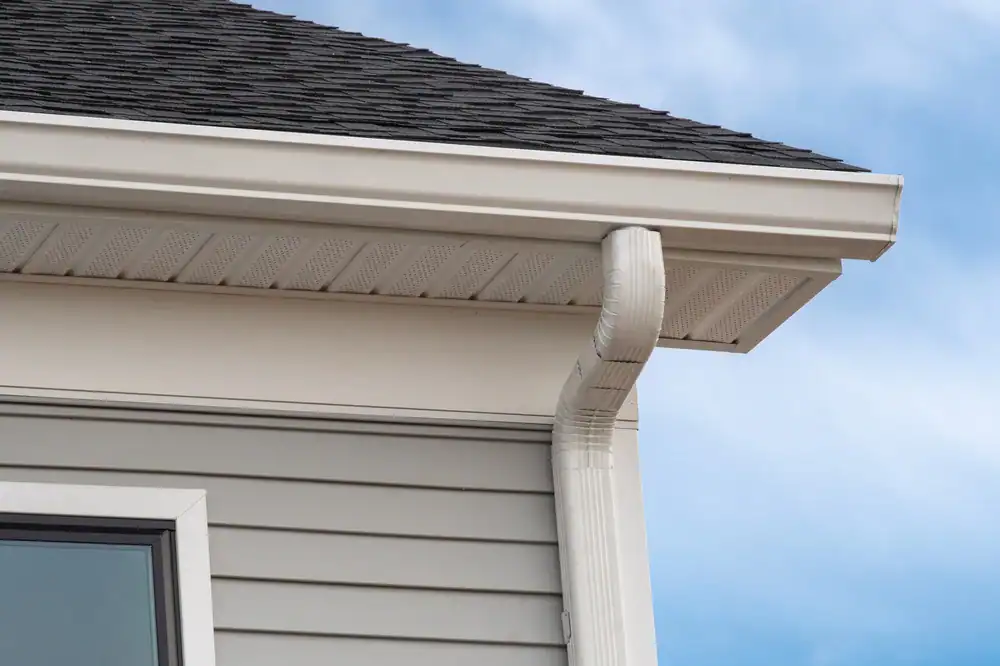
Cleaning the gutter is only part of the job. One of the most common mistakes we see — and one that costs homeowners real money — is focusing entirely on the gutter while ignoring the fascia board it’s mounted to. Fascia is the horizontal board that runs along the edge of your roofline, and it’s what your gutters are anchored into. When gutters overflow consistently, water sits against that board and starts breaking it down. Over time, the wood softens, the fasteners lose their grip, and the gutter begins to pull away from the house.
If you’ve noticed your gutters sagging or separating from the roofline, that’s usually not a gutter problem — it’s a fascia problem that’s showing up through the gutter. Installing a new gutter on rotted fascia is a short-term fix at best. The board needs to be repaired or replaced first, or the new system will fail just as quickly as the old one.
Beyond fascia, check your downspouts. Industry best practice puts one downspout for every 20 to 30 linear feet of gutter. If yours are spaced further apart than that, your system is working harder than it should be during heavy rain. Also check where the downspouts discharge — water should be directed at least four to six feet away from your foundation. In Spring Valley, where hillside terrain can channel water toward the home rather than away from it, downspout placement and extensions aren’t optional details. They’re the difference between a functioning drainage system and a foundation that’s quietly absorbing water every winter.
One more thing worth mentioning, particularly for homeowners in Alpine, Bonita, Spring Valley, and Temecula: dry debris in your gutters is a fire hazard. Cal Fire recommends clearing gutters as part of home hardening in wildland-urban interface areas, and all four of those communities have meaningful fire exposure. Gutter maintenance in these areas isn’t just about water — it’s about reducing the risk of ember ignition during fire season.
Want live answers?
Connect with a MRH Pro Construction & Painting expert for fast, friendly support.
With the local context in mind, here are the five maintenance practices that make the biggest difference for homes in Temecula, Spring Valley, Escondido, Encinitas, Oceanside, Chula Vista, Alpine, and Bonita. These aren’t complicated. They’re just the things that consistently separate homeowners who deal with water damage from the ones who don’t.
The goal isn’t to turn you into a gutter expert. It’s to give you enough working knowledge to stay ahead of the problems that are most likely to affect your specific home in this specific climate.
Tip one: clean before the season, not after the damage. October is the window. The rainy season in San Diego County typically arrives in November, and by then you want your gutters clear, your downspouts flowing freely, and your fascia in solid shape. Waiting until December — or until you see water pouring over the sides during a storm — means you’re already reacting to a problem instead of preventing one.
Tip two: do a post-rain inspection in spring. After the rainy season wraps up in March or April, take a look at what’s accumulated. Winter debris — broken twigs, compacted leaves, shingle grit — can leave gutters in worse shape than they went in. Spring is also when jacaranda season begins, so a cleaning in April or May sets you up before the bloom cycle adds another layer of debris.
Tip three: check your slope. Gutters should drop roughly a quarter inch for every ten feet of run toward the downspout. If water is sitting in your gutters between rain events instead of draining out, the pitch is off. Standing water breeds mosquitoes, accelerates rust on steel gutters, and adds weight that strains the mounting hardware. This is something we can correct during an inspection — it’s not a major job, but it makes a real difference in how the system performs.
Tip four: match your materials to your environment. If you’re in Encinitas or Oceanside, salt air is a real factor. Vinyl gutters degrade faster in coastal environments, and standard steel can rust without protective coating. Aluminum is the most practical choice for most San Diego County homes — it’s rust-resistant, handles UV exposure well, and holds up in both coastal and inland conditions. Copper is an excellent long-term option if you’re willing to invest in it. The material conversation matters because the right gutter in the right environment simply lasts longer.
Tip five: don’t ignore gutter guards if you have heavy tree coverage. Guards won’t eliminate maintenance entirely — fine debris like pine needles and shingle grit can still accumulate — but they significantly reduce how often your gutters need attention. For homes in Temecula’s wine country hills, in Bonita’s tree-lined neighborhoods, or anywhere in Alpine, the reduction in cleaning frequency alone makes them worth considering.
One question we hear often is: “How do I know if I need new gutters or just a cleaning?” The honest answer is that cleaning solves most problems — but there are clear signs that replacement is the right call. If your gutters are pulling away from the fascia, if you’re seeing visible cracks or holes, if they’re rusting through, or if they continue to overflow even after a thorough cleaning, those are signs the system has reached the end of its useful life. Sagging gutters in particular almost always point to either failed fasteners or rotted fascia behind them, and that’s a situation where a professional inspection will tell you more than a cleaning will.
Another common one: “Are seamless gutters worth the extra cost?” In most cases, yes. Sectional gutters — the kind assembled from pre-cut pieces — have joints at every connection point, and joints are where leaks start. Seamless gutters are fabricated in one continuous run, which eliminates most of the failure points. They look cleaner, they perform better over time, and they require less maintenance. The cost difference over a typical San Diego County home isn’t dramatic, and the long-term performance difference is real.
Homeowners in Chula Vista’s newer neighborhoods often ask whether their homes need gutter maintenance at all. They do. New gutters still collect debris, still need proper slope, and still require periodic inspection. The age of the gutter doesn’t change what falls into it or how San Diego County’s compressed rainy season affects it.
And finally: “Do I need a permit for gutter installation in California?” For most standard residential gutter installations, no permit is required. However, California law requires a licensed contractor for any construction project exceeding $500 in labor and materials combined. That’s not a technicality — it’s a protection for you as a homeowner. Working with an unlicensed contractor on a project of that size leaves you with no recourse if the work fails or causes damage. You can verify any contractor’s license through the California Contractors State License Board at cslb.ca.gov before anyone sets foot on your property.
Gutters aren’t glamorous, but they’re doing real work for your home every time it rains — protecting your foundation, your siding, your stucco, your fascia, and your windows from water that has nowhere else to go. In a climate like San Diego County’s, where the rainy season arrives fast and hits concentrated, the homes that come through without damage are almost always the ones where someone paid attention before November.
The five tips here — timing your cleanings, inspecting beyond the gutter itself, checking your slope and downspout placement, choosing the right materials for your environment, and considering guards if you have heavy tree coverage — aren’t complicated. They’re just consistent.
If you’re in Temecula, Spring Valley, Escondido, Encinitas, Oceanside, Chula Vista, Alpine, or Bonita and you’re not sure where your gutters stand heading into the season, we’re happy to take a look. We’ve been working on San Diego County exteriors for 16 years, and we handle everything from gutter inspection and installation to fascia repair, siding, stucco, and painting — so nothing gets missed. Reach out and we’ll get you a straight answer and a clear estimate.
Article details:
Share:
Continue learning: